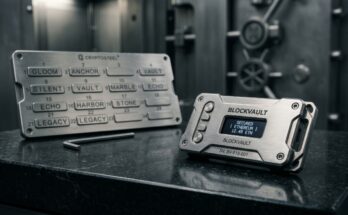

You’ve likely experienced that sinking feeling of dread when you realize you’ve forgotten a password. In the traditional world, you simply hit “Forgot Password,” wait for an email link, and you’re back in business. In the world of crypto self-custody, however, “Forgot Password” usually means “Permanent Financial Ruin.” If you lose your 24-word seed phrase, your assets vanish into the digital ether, and there is no “customer support” to call.
For years, this binary ofperfect responsibility or total loss has been the biggest barrier keeping mainstream users away from decentralized finance. The solution is finally here, and it’s surprisingly human: Social Recovery. By shifting the burden of security from a single, fragile paper scrap to a network of trusted companions, you can now enjoy the benefits of self-custody without the constant, gnawing fear of losing everything.
The Architecture of Trust: How Social Recovery Works
At its core, a social recovery wallet is a smart-contract-based account that replaces the “one key to rule them all” model with a more flexible, programmable logic. Instead of relying solely on a private key that you must memorize or hide in a physical safe, these wallets allow you to designate a group of “guardians”—trusted friends, family members, or even your own secondary devices—who hold the power to help you regain access if you lose your primary signing key.
When you lose your wallet or forget your credentials, you initiate a recovery request on the blockchain. Your designated guardians are notified, and once a pre-defined threshold—like 3 out of 5 guardians—approves your request via their own secure devices, the smart contract automatically updates your account’s signing authority. The old, lost key is revoked, and a new one is authorized. You are back in control, and you never had to scribble 24 random words on a piece of paper.
Expert Insight: I often compare this to a digital version of a multi-signature safe. You aren’t giving your friends access to your funds—they can’t steal your money. They are simply acting as human authenticators. They verify that you are the person asking to get back into your account, and that collective “yes” is all the protocol needs to unlock the door for you again.
Moving Beyond Seed Phrases: Why This Is a Paradigm Shift
The mnemonic phrase system was never designed for the average person. It requires an level of operational security discipline that is, frankly, inhuman. We lose things. We get distracted. We make mistakes. The social recovery crypto wallet acknowledges this reality by moving the security “policy” on-chain rather than leaving it in your hands.
This shift enables a much smoother onboarding experience for everyday users. You can set up an account using familiar identifiers like your email, phone number, or a Google/Apple login, while the underlying smart contract ensures that your assets remain strictly under your control. The protocol handles the complex cryptography, while you handle the human side of the equation.
Personal Example: I remember testing a social recovery flow for a new wallet project. I purposefully deleted my primary authentication device to see if the recovery worked. My “guardians” were just my own secondary phone and a laptop running a different wallet instance. The recovery process felt exactly like recovering a standard social media account, yet my assets remained fully non-custodial and secure. It felt like magic, but it was just good code.
The Human Element: Choosing Your Guardians Wisely
The effectiveness of this model hinges entirely on your guardian selection. While it’s technically possible to designate anyone, you should think of these roles as your “digital inheritance committee.” Choose people who are technologically literate, reachable, and, most importantly, people you would trust with your life.
Your guardians don’t need to know each other, and in fact, it’s often safer if they don’t. By distributing the “shares” of your recovery power among diverse contacts, you ensure that no single person—or group—can collude to hijack your account. You can also update your guardian list at any time, adding or removing contacts as your personal relationships change over the years.
Expert Insight: A crucial security feature in most social recovery setups is the “time delay.” When a recovery is initiated, there is often a 24 to 72-hour window before the change is finalized. This acts as a circuit breaker; if a hacker manages to compromise your account, you have a window of time to see the alert and cancel the request before the ownership is transferred.
Navigating the Risks and Implementation Trade-offs

No system is without its nuances. The primary risk of a social recovery model is the “guardian absence” scenario. If you choose guardians who lose their own phones or stop using the platform, you could find yourself in a difficult position during an emergency. It is essential to periodically check in with your guardians, ensuring they still have their own devices configured to approve requests.
Furthermore, there is a minor risk of “guardian collusion” if you choose people who all live in the same house or share a single point of failure. Always prioritize geographic and social diversity in your guardian list. If you choose your parents and your spouse, make sure they aren’t all carrying their own recovery devices in the same physical bag!
Expert Insight: If you are a high-net-worth investor, don’t rely only on social recovery. The best-in-class security strategy is a “defense-in-depth” approach: use a hardware wallet for your core long-term savings, and a social recovery wallet for your day-to-day spending and DeFi interactions. This gives you the best of both worlds: extreme security for your life savings and extreme convenience for your active capital.
Conclusion
The era of “be your own bank” shouldn’t require you to be your own security engineer. By leveraging the power of social recovery, we are finally making crypto accessible to people who don’t want to spend their lives guarding a secret list of words. This technology turns security from a lonely, high-stakes burden into a shared, reliable process.
It is time to stop viewing self-custody as a dangerous game of “don’t lose the paper.” Choose a modern, smart-account-based wallet, set up your guardians, and take the stress out of your financial future. Your keys are important, but your peace of mind is worth far more.
FAQ
What if all my guardians go offline at the same time?
This is why guardian selection is vital. Always ensure you have a “n-of-m” threshold (e.g., 2 out of 3, or 3 out of 5) and choose guardians with diverse backgrounds, locations, and device types to ensure at least a few are always reachable.
Can my guardians steal my funds?
No. A social recovery wallet is designed so that guardians only have the power to help you regainaccess to your own account. They never have the authority to move your funds or initiate transactions on your behalf.
Do I have to pay my guardians to perform this service?
Generally, no. It’s a social service between trusted parties. However, in the future, we may see decentralized services where you can pay small fees to professional “recovery bots” or specialized firms to act as guardians.
How is this different from a multi-sig wallet?
A multi-sig wallet requires multiple signatures toapprove every transaction. A social recovery wallet works like a normal wallet where you are the sole signer—the guardians only come into play if you lose your primary access.