
You’ve likely seen the exhilarating gains of a bull market and thought to yourself, “I wish I could just capture some of this upside without betting everything on a single volatile asset.” We constantly hunt for ways to earn yield that don’t involve the stomach-churning risk of massive price swings. Most people assume the only way to make money in crypto is through directional speculation—buying low and selling high. They are missing out on one of the most consistent, data-driven revenue streams in the entire digital ecosystem: funding rates.
If you aren’t familiar with Crypto Funding Rates Explained, you are effectively leaving money on the table every single time the market enters a period of intense bullish euphoria. This mechanism is the heartbeat of perpetual futures markets, and once you understand how to harness it, you can potentially turn market volatility into your own personal ATM. Let’s demystify how this works and why exchanges essentially pay you to maintain balance in the market.
The Balancing Act: How Perpetual Futures Stay Anchored
Perpetual futures contracts are a brilliant invention. Unlike traditional futures, they have no expiration date. You can hold them forever, which makes them incredibly convenient for traders. However, this creates a massive problem for the exchange: how do they ensure the price of the perpetual contract stays pegged to the actual spot price of the asset?
If there were no anchoring mechanism, the price of a perpetual Bitcoin contract could drift hundreds of dollars away from real Bitcoin, making it useless as a trading instrument. The funding rate is the solution. It is a recurring fee paid directly between traders to keep the contract price in line with the spot price.
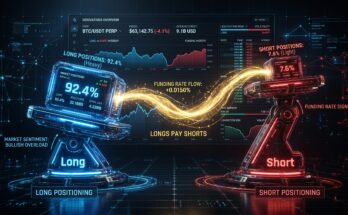
Expert Insight: Think of the funding rate as an “interest rate” on leverage. When the market is hyper-bullish, there are far more people trying to go “long” (betting the price will rise) than “short” (betting it will fall). To incentivize more people to take the short side and bring the price back down to earth, the long traders are forced to pay a fee to the short traders every few hours.
Profiting from the Delta: Capturing the Yield
You don’t have to be a genius trader to profit from funding rates. In fact, many professional traders employ a “delta-neutral” strategy to capture this yield while ignoring the price action of the asset entirely. This is the secret sauce behind many high-yield stablecoin protocols you see today.
Here is the simple breakdown: you buy an asset in the spot market and simultaneously open an equal-sized short position in the perpetual futures market. Because you own the asset and are also shorting it, you are effectively “hedged.” If the price crashes, your short position gains value exactly as much as your spot holding loses it. Your total portfolio value stays static, but you are still collecting those sweet funding rate payments every eight hours.
Personal Example: I once ran a delta-neutral position during a period of extreme market hysteria. Everyone was foaming at the mouth to go long on Ethereum, and funding rates spiked to 0.1% every four hours. By holding a hedged position, I was banking 0.6% in yield per day. That’s a massive annualized return just for keeping the market balanced, with zero exposure to ETH price volatility.
When to Flip the Strategy: Understanding Market Skew
Timing is everything. Funding rates are not a guaranteed infinite money glitch; they are a market signal. They tell you exactly how the crowd is feeling. When the funding rate is positive, the “longs” are paying the “shorts.” When the funding rate is negative, the “shorts” are paying the “longs.”
If you see a negative funding rate, it means the market is terrified. Everyone is betting on a crash, so the exchange pays people to open long positions to stabilize the price. This is often a contrarian signal that a short-term price bounce might be imminent.
Expert Insight: Never blindly chase the highest funding rate. If the rate is 0.5% every four hours, you have to ask yourself why. Is the market so skewed that a “short squeeze” is about to happen? If you are shorting an asset just for the yield, and the market suddenly rips upward, your short position could be liquidated, wiping out weeks of yield in a single heartbeat.
Managing the Risks of Leveraged Yield
We have to be realistic about the dangers. Capturing funding rates often requires you to use leverage on your futures position. If you miscalculate your hedge or if the exchange has a liquidity crisis, you could lose your principal.
You are also exposed to “funding risk.” In a bear market, funding rates can stay neutral or negative for weeks. Your yield can evaporate, or you could end up paying out instead of receiving. Always maintain a buffer of margin in your account. If the price of your asset moves rapidly against your hedge, you need to ensure you have enough collateral to keep your positions open, or the exchange will close them for you.
Expert Insight: Before you start, calculate your “break-even” point. Account for trading fees, slippage, and the cost of borrowing. If the funding rate yield isn’t significantly higher than the combined cost of these factors, the strategy isn’t worth the operational headache.
Conclusion

Understanding Crypto Funding Rates Explained is a major level-up for any serious trader. It shifts your mindset from “guessing where the price will go” to “collecting the premium the market pays for stability.” While it isn’t risk-free, it is one of the most reliable ways to earn consistent returns in a landscape usually defined by uncertainty.
Start small. Watch the funding rates on a few major assets, track how they correlate with price movements, and experiment with a small, hedged position. Once you see that first funding payment hit your account, you will understand exactly why the pros love this market. Ready to start putting market sentiment to work for your wallet? Open your exchange dashboard and see what the market is currently paying to keep its balance.
FAQ
Where can I see the current funding rates? Almost every major derivatives exchange—such as Binance, Bybit, or OKX—has a “Market Info” or “Funding History” section. You can also use third-party aggregators like Coinglass to track rates across the entire industry in real-time.
How often are these payments made? It varies by exchange, but the industry standard is usually every 8 hours. Some newer platforms have moved to 4-hour or even 1-hour settlement periods to keep prices tighter.
Is this yield taxable? Yes. In most jurisdictions, funding rate payments are treated as income. Keep meticulous records of every payment received, as you will likely need to report them as ordinary income on your taxes.
Can I get liquidated even if I am hedged? Technically, yes. If the price of the asset moves so violently that your futures position hits its margin limit before your spot position can be sold, you could face liquidation. Always keep your margin levels healthy and use a larger cushion than you think you need.