
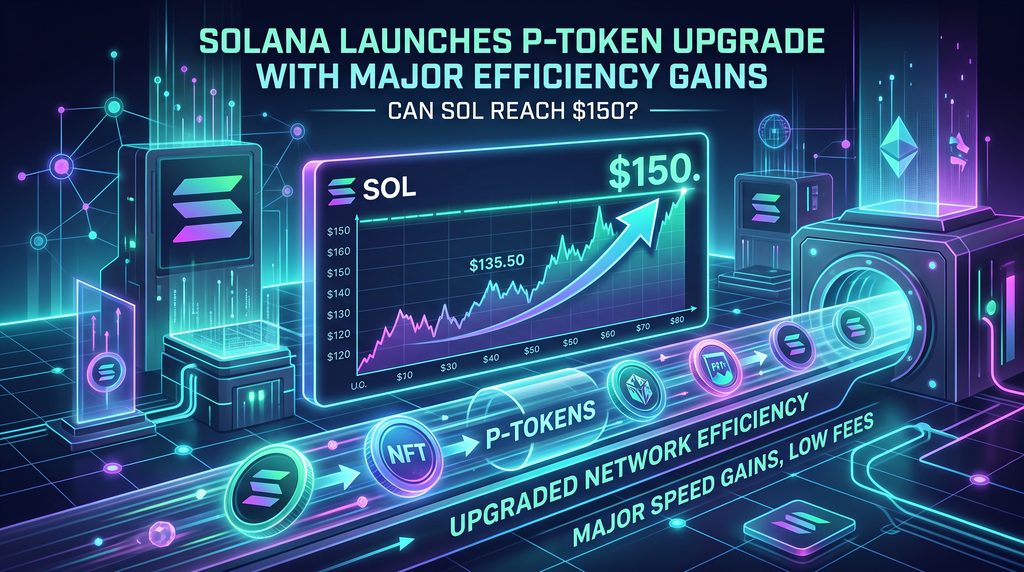
You watch Solana transaction fees and congestion swing with every market surge. Token transfers, mints, and account actions eat compute units and crowd blocks. In May 2026 the network activated a quiet but important fix: the P-Token upgrade, also called the Optimized Token Program.
This change rewrites the core token program so common operations use far fewer compute units. Developers describe efficiency gains approaching 20x for many instructions. The upgrade is live on mainnet, fully backward compatible, and already free up measurable block space. Whether that technical win translates into a sustained price move toward $150 remains an open question that depends on much more than one upgrade.
What Exactly Is the P-Token Upgrade?
P-Token is an optimized re-implementation of Solana’s SPL Token program, formalized in SIMD-0266 and built with the Pinocchio framework. It keeps the same program ID and instruction interface, so existing wallets, apps, and tokens continue working without changes.
The big difference sits under the hood. A standard token transfer that once consumed roughly 4,645 compute units now uses about 76. Similar reductions apply to approve, burn, mint, and account-initialization instructions—often 95-98% lower compute cost. Network-wide, the change frees an estimated 10-13% of block space without raising block limits.
I have followed Solana’s performance work for years. Most upgrades target consensus or parallel execution. This one attacks the single most common workload on the chain—token operations—and does it without forcing developers to rewrite code.
Why the Efficiency Jump Matters for Users and Builders
Cheaper compute for token actions means more transactions can fit into each block. During busy periods that extra capacity can reduce failed transactions and keep fees more predictable. Complex DeFi transactions that combine multiple token instructions also become less likely to hit compute ceilings.
For developers the benefit is practical. Apps that previously optimized aggressively around token-program costs now have headroom for additional logic. New features that once felt too expensive in compute terms become realistic. The upgrade also adds a few new instructions for batching and recovering excess lamports, giving builders extra tools.
Price Speculation and the $150 Question
Technical upgrades rarely move price by themselves. Solana’s valuation responds to broader liquidity, ETF flows, meme-coin and DeFi activity, macroeconomic conditions, and competition from other high-throughput chains. A 10-13% effective capacity increase is meaningful infrastructure progress, yet it sits alongside many other factors.
Some traders view sustained efficiency gains as supportive of higher long-term valuations because they improve the user experience and developer economics. Others note that Solana has delivered multiple performance upgrades in recent years without automatic price multiples. Reaching $150 would require a combination of strong network usage, favorable market structure, and continued execution—not just one token-program rewrite.
Treat round-number price targets as speculation. Focus instead on measurable adoption metrics: stablecoin volume, DeFi total value locked, daily active addresses, and real fee generation. Those numbers ultimately matter more than any single upgrade headline.
What Comes Next for Solana Infrastructure
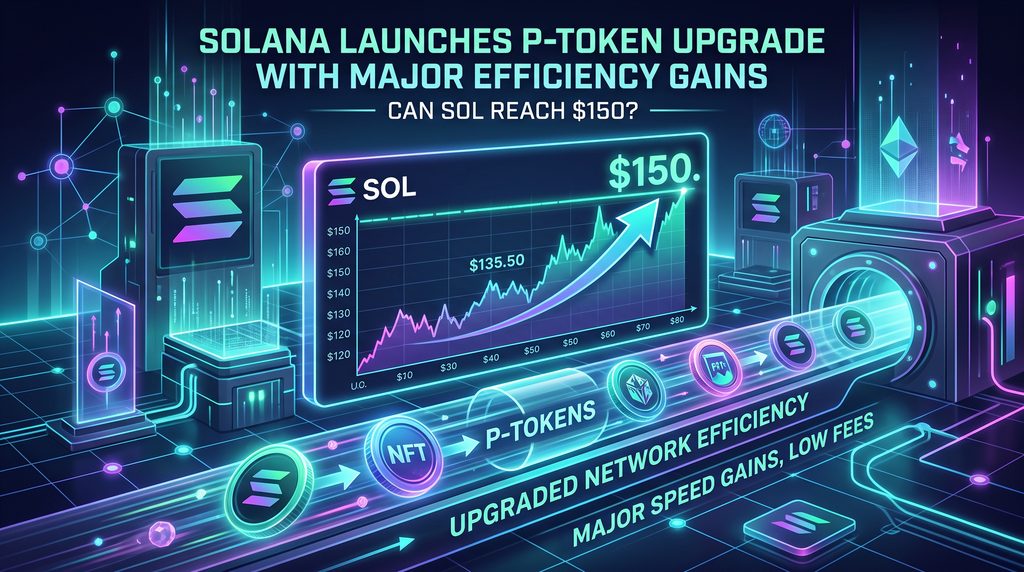
P-Token joins a longer list of efficiency and reliability work. The network continues refining consensus, client implementations, and developer tooling. Formal verification of the new token program by third parties has added confidence that the performance gains did not introduce hidden behavioral changes.
For holders and users the practical takeaway is straightforward. Token operations are now significantly cheaper in compute terms, the change required no migration, and the network has modestly more capacity. That combination strengthens Solana’s position as a high-throughput environment, even if it does not guarantee any particular price level.
FAQ
Is P-Token already live?
Yes. The Optimized Token Program activated on Solana mainnet in May 2026.
Do existing tokens and wallets need updates?
No. The upgrade is backward compatible. Most users and applications continue working without changes.
How much more efficient are token transfers?
Compute usage for a basic transfer dropped from roughly 4,645 units to about 76—an improvement on the order of 60x for that specific instruction, with many operations seeing 95-98% reductions.
Will this lower my transaction fees immediately?
Fees depend on network demand. The extra block space can help during congestion, but fee markets still respond to overall activity.
Does the upgrade affect SOL’s monetary policy or inflation?
No. It is a pure efficiency change to the token program and does not alter issuance or staking mechanics.
Should I expect SOL to reach $150 because of this?
Price targets are speculative. The upgrade improves capacity and developer experience, yet market price depends on many additional factors.
Leave a Reply