You watched JST trade for months in a lower range and wondered whether the token could ever reclaim meaningful ground. Then TRON’s DeFi stack activated a consistent buyback-and-burn program funded by real protocol revenue. The mechanism has already removed a substantial portion of supply, and the price has responded.
By mid-2026 JST had not only reached but clearly surpassed the $0.060 level, pushing through $0.10 at points after four completed burn cycles. The more relevant question now is whether the same revenue-driven deflation can support further gains or at least help defend higher prices. The answer rests on the durability of JustLend and related TRON DeFi activity that funds the buys.
How the Buyback-and-Burn Program Works
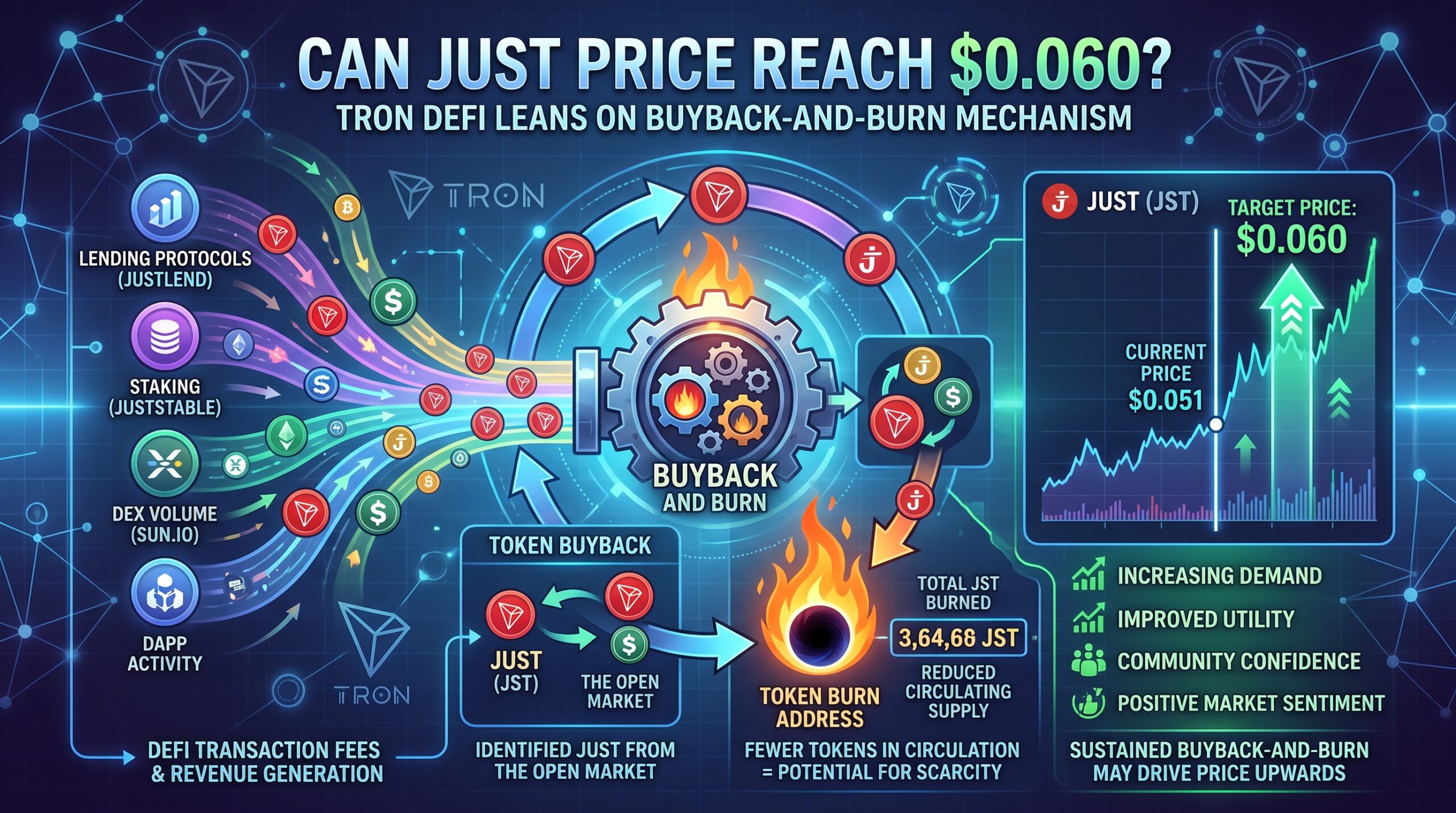
JUST introduced a formal revenue-linked buyback-and-burn system in October 2025 after community approval. Protocol earnings, primarily from JustLend DAO energy leasing and other fees, are used to purchase JST on the open market. Those tokens are then sent to a burn address and permanently removed from circulation.
Four cycles have been completed. The latest (July 2026) destroyed more than 355 million JST, valued at roughly $34.6 million at the time. Cumulatively the program has burned about 1.711 billion JST—approximately 17.29% of the original maximum supply—at a total value exceeding $94 million. Part of the fourth cycle also included historical USDJ stability fees, broadening the funding sources.
This is not a one-off marketing burn. It is a recurring, on-chain process tied directly to protocol performance. When JustLend generates more revenue, the buyback capacity increases.
Why the Mechanism Has Already Moved the Needle
Supply reduction on this scale changes the float. With nearly one-fifth of the original supply removed in under a year, each remaining token represents a larger share of the network. Markets noticed. JST climbed from the low $0.03 area before the program began to levels above $0.10, a move that carried it through the $0.060 zone with conviction.
The price appreciation occurred alongside rising trading volume and a higher market-cap ranking. That combination suggests the burns were not the sole driver, yet they provided a clear, measurable tailwind that pure governance tokens often lack. I have followed many “buyback” announcements that produced little lasting effect because the funding proved temporary or the execution opaque. JUST’s version has been relatively consistent and transparent.
Can the Deflationary Pressure Continue?
Future burns depend on sustained or growing protocol revenue. JustLend’s energy-leasing business and related TRON DeFi activity must keep generating the USDT (or equivalent) used for purchases. If TRON DeFi Summer narratives and real usage continue, the quarterly buyback capacity can remain material. If activity stagnates, the size of future burns will shrink.
Even at a slower pace, ongoing removal of tokens still exerts gradual upward pressure on the remaining supply. The key variable is whether revenue stays high enough to make each cycle meaningful relative to circulating supply and daily trading volume. Traders should track JustLend’s reported earnings and the size of each subsequent burn announcement rather than assume linear continuation of the early aggressive pace.
Price Outlook Beyond $0.060
Because JST has already traded meaningfully above $0.060, that level now functions more as historical support than as a forward target. Holding above it during market-wide pullbacks would demonstrate that the reduced float and residual demand have staying power. A sustained move back toward or beyond recent highs would require continued revenue growth, positive TRON ecosystem sentiment, and broader crypto market cooperation.
No buyback program guarantees higher prices in every market condition. It does improve the supply side of the equation and aligns token value more closely with protocol success. That alignment is rarer than most marketing claims suggest.
FAQ
Has JST already reached $0.060?
Yes. The token moved through that level and reached above $0.10 during 2026 as the buyback program progressed.
How much JST has been burned so far?
Approximately 1.711 billion tokens across four cycles, equal to about 17.29% of the original maximum supply.
Where does the buyback funding come from?
Primarily JustLend DAO revenue (especially energy leasing) plus, in the latest cycle, accumulated USDJ stability fees.
Is the burn program permanent?
It is a recurring mechanism approved by governance and funded by ongoing protocol earnings. Its size will vary with revenue.
Does a buyback-and-burn guarantee further price increases?
No. It reduces supply and can support price, but demand, market conditions, and competing narratives still dominate short-term moves.
What should holders monitor?
Quarterly burn sizes, JustLend revenue trends, circulating supply updates, and overall TRON DeFi activity.
Leave a Reply