
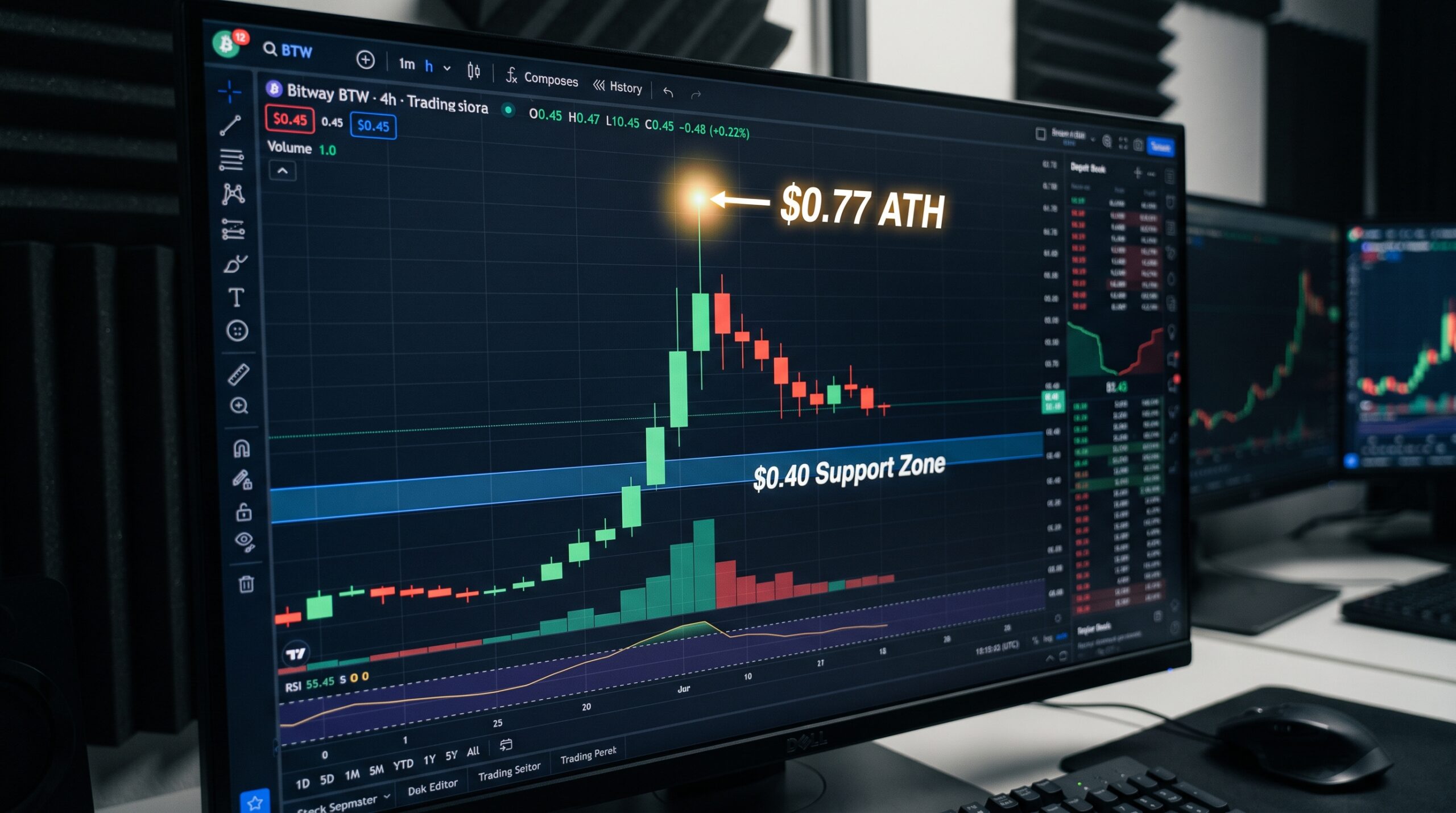
You caught the vertical move or you watched it from the sidelines. Bitway (BTW) ripped higher in a matter of days, posting gains near 250% from its recent breakout zone and briefly tagging a record high near $0.77. Now the candle is cooling. Price sits back in the $0.41–$0.45 area after that sharp pullback. The question every trader is asking is the same one: is this just profit-taking, or has the fuel run out?
The structure still looks constructive. Buyers stepped in on the way up with real volume, futures open interest expanded, and the project’s own catalysts kept stacking. A healthy retreat after a parabolic stretch is normal. What matters is whether the higher lows and key support levels continue to hold.
What Drove the Explosive Rally
Bitway did not move in isolation. Multiple catalysts lined up at the same time. Futures listings on major venues earlier in the summer opened the door to leveraged speculation. That alone created the first sharp spikes. Then successive Binance Wallet Booster campaigns and an attractive USDT staking yield inside the Bitway ecosystem pulled in fresh deposits and attention.
Circulating supply remains relatively tight compared with the full 10 billion max. Only about 2.7 billion tokens are out there. When demand spikes against limited float, price reacts fast. Trading volume jumped hard during the push, and open interest in perpetual contracts climbed into the hundreds of millions. Those are the classic ingredients of a momentum-driven run.
I have seen this pattern before on other mid-cap names. When derivatives activity and real product incentives fire together, the chart can look almost vertical until short-term holders decide to bank gains.
Where Price Stands After the Pullback
The daily candle that printed the high carried a long upper wick. Sellers showed up above $0.70 and forced an 18%+ retracement in short order. That is classic post-parabolic behavior. Yet the token is still trading well above the levels that started the latest leg higher. From the early-August breakout zone near $0.20–$0.22, the net gain remains substantial even after the cooling.
Key support now clusters around the $0.40–$0.42 zone on the lower timeframes, with a deeper level near $0.35–$0.38 if sellers press harder. On the upside, reclaiming and holding above $0.50 would signal that the correction is complete and buyers are ready for another attempt at the recent highs. RSI cooled from extreme overbought readings near 87, which removes some of the immediate pressure.
Volume has come down from the peak days, but it has not collapsed. That keeps the door open for continuation rather than a full trend reversal.
On-Chain and Market Flow Signals Worth Watching
Exchange outflows during the rally suggested tokens were moving into private wallets rather than sitting ready for immediate sale. That kind of behavior often supports longer holding periods. At the same time, the rapid expansion in futures open interest means leverage is still elevated. High leverage cuts both ways. A clean break of support can trigger cascading liquidations just as easily as a bounce can force short covering.
The Bitway Earn products and vault activity continue to show growing total value locked. That fundamental layer sits underneath the pure price speculation and gives the token a narrative that pure meme names lack. Projects that combine yield mechanisms with visible user growth tend to recover faster after sharp corrections.
Practical Approach for Traders Right Now
If you rode the surge, the current zone is a natural place to review position size. Trailing stops under the $0.40 area protect the bulk of gains without forcing an early full exit. Fresh capital can wait for either a clear reclaim of $0.50 with rising volume or a successful test and bounce from the $0.40 support before adding.
Risk management matters more than perfect timing after a 250% move. Scale entries and exits. Avoid the temptation to size up just because the previous candle looked strong. Volatility remains high, and the next 48–72 hours will likely decide whether this pullback stays shallow or deepens.
Broader market conditions still play a role. If Bitcoin and the majors hold steady or grind higher, mid-cap momentum names like Bitway usually find buyers more easily. A sudden risk-off shift would pressure everything, including this chart.
What the Next Move Could Look Like

The 250% surge delivered the excitement. The retreat is testing conviction. As long as price holds above the key support cluster and volume does not dry up completely, the path of least resistance remains higher over the coming sessions. A decisive close back above $0.50 would put the recent highs back in play. Failure to defend $0.40 would open a deeper retest of the earlier August levels.
Stay focused on the levels that actually matter rather than every social-media prediction. Watch the $0.40–$0.42 zone, the volume profile, and whether open interest starts to rebuild on the long side. Those three factors will tell you more than any single headline.
Have your plan ready before the next large candle prints. The market rarely rewards hesitation after a move this size.
FAQ
Why did Bitway surge so hard in the first place?
A combination of futures listings, Binance Wallet incentive campaigns, tight circulating supply, and rising derivatives open interest created the perfect storm for a rapid re-pricing.
Is the current pullback a sign the rally is over?
Not necessarily. Sharp advances almost always produce profit-taking. The structure remains constructive as long as higher lows and the $0.40 support area continue to hold.
What are the key levels to watch on Bitway right now?
Support sits near $0.40–$0.42 with a deeper zone around $0.35–$0.38. Resistance begins at $0.50, followed by the recent high near $0.75–$0.77.
Should I buy the dip or wait?
That depends on your risk tolerance. Waiting for confirmation above $0.50 or a successful bounce from support keeps risk more controlled than chasing the initial vertical move.
How important is the low circulating supply?
Very. With only about 27% of the max supply in circulation, even moderate new demand can produce outsized price moves in both directions.
Leave a Reply